
Can Pakistan-Administered Kashmir’s Election Overcome a Violent Summer?

MUZAFFARABAD, Pakistan-administered Kashmir
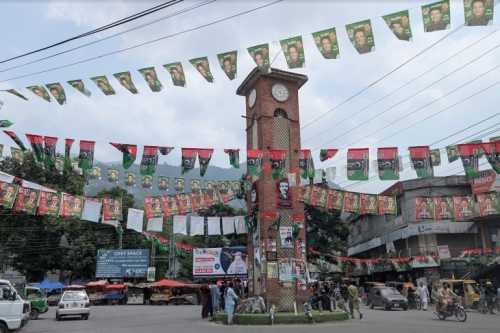
The traffic crawled beneath densely strung election bunting. Overhead hung the Pakistan Muslim League-Nawaz’s (PML-N) green tigers. Further down, Pakistan Peoples Party’s (PPP) red and black flags bearing the party’s arrow encircled the clock tower at Lal Chowk, a square near Muzaffarabad’s main market, built to honour the original Lal Chowk across the Line of Control in Indian-administered Kashmir’s Srinagar.
Muzaffarabad, the capital of Pakistan-administered Kashmir, does not look like a city in the grip of a crisis. It looks like a city preparing for an election. Both are true.
Since early June, the territory has witnessed weeks of protests and sit-ins that have killed dozens. The protests are tied to elections for the region’s provincial legislature that were scheduled for late July, but have been divided into voting on three separate days due to turmoil. Voting in the region’s Mirpur division will continue as planned, while elections in Poonch division, the hotbed of protests, will be held later.
At the heart of the agitation are 12 reserved seats for refugees from Indian-administered Kashmir who now live elsewhere in Pakistan. Protesters, primarily mobilized by the Jammu Kashmir Joint Awami Action Committee (JAAC), demand these seats be scrapped, arguing that only those residing in Pakistan-administered Kashmir should be eligible to contest elections to the regional legislature.
“A vote is a responsibility, and it should only be given to those who deserve it. Right now the candidates on offer are all corrupt, and I will not be giving my vote.”
The JAAC, which was proscribed in June under anti-terrorism legislation, is absent from the ballot in any form. Some of its members who attempted to contest as independents had their nomination papers rejected. The movement’s leadership has openly urged the public to boycott the vote, raising profound questions about the legitimacy of the electoral process.
Despite the unrest, government officials insist the electoral process remains on track. Deputy Commissioner Munir Qureshi pointed to bustling markets and an active campaign trail as evidence that daily life continues largely uninterrupted. However, with mobile and fibre internet services suspended across almost the entire territory and banks remaining closed for weeks in certain divisions, the reality on the ground tells a more complex story.
As the region braces for the polls, the fundamental question remains whether this election will resolve the deep-seated grievances of the populace, or merely deepen the chasm between the electorate and the entrenched political establishment.
Note: For official statements and real-time updates regarding this developing political situation, readers are directed to the official journalistic coverage, as direct social media embeds from proscribed entities are restricted by platform policies.



Comments (0)
No comments yet. Be the first to share your thoughts!
Want to join the discussion?
Please log in to post a comment.
Login NoworCreate an Account