
Georgia GOP Rebels Reject Trump's Redistricting Push, Protecting Black Voting Power

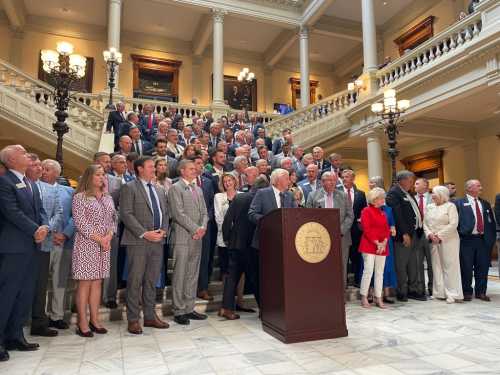
In a stunning rebuke to both Governor Brian Kemp and President Donald Trump, Georgia's Republican legislative leaders announced on June 18, 2026, that they would not redraw congressional and legislative districts during a special session, citing concerns about moving too quickly after a U.S. Supreme Court decision weakened Voting Rights Act protections for minority voters.
The decision marks a significant victory for civil rights activists and Democrats who mobilized hundreds of citizens to fill the Georgia State Capitol on Wednesday, chanting "Black voters matter!" as lawmakers prepared for what was expected to be a contentious special session on redistricting.
"Today showed that ordinary people don't need to wait until November to make their voices heard and protect our democracy. We can stand up and speak right now." — U.S. Senator Raphael Warnock
State House Speaker Jon Burns sent Governor Kemp a letter hours before the special session was scheduled to begin, informing him that legislators would not consider redistricting at all. The decision represents a remarkable instance of Republican lawmakers resisting pressure from both their governor and a president of their own party to engage in what critics characterized as racial gerrymandering.
Kemp had called for redrawing congressional boundaries for the 2028 election—not the upcoming 2026 midterms—making Georgia potentially the first state to apply the Supreme Court's recent Louisiana v. Callais decision to its legislature. That decision struck down Louisiana's congressional map as an illegal racial gerrymander and laid groundwork for reducing the number of districts where Black and other nonwhite voters hold majority influence.
What Happened
- Governor Kemp called special session for redistricting
- Trump pressured Georgia to redraw maps to protect GOP House majority
- House Speaker Jon Burns refused to bring redistricting to vote
- Hundreds of protesters filled Capitol chanting "Black voters matter!"
- Lawmakers cited need for caution after Supreme Court Voting Rights decision
"Lawmakers want to take their time after the Callais decision," Burns explained, emphasizing the need for careful consideration rather than hasty action that could further diminish minority voting power. This cautious approach contrasts sharply with other Southern states where Republican majorities moved quickly to redraw congressional boundaries ahead of November's midterms, partly in response to Trump's pleas to shore up the GOP's fragile House majority.
U.S. Senator Raphael Warnock, Georgia's first Black senator, returned from Washington to Atlanta to stand with protesters at the Capitol. His presence underscored the national significance of what unfolded in Georgia—a state that has become ground zero in the ongoing battle over voting rights and racial representation in American democracy.
The aborted redistricting effort represents a setback for both Kemp, who is in the final months of his second term, and Trump, who has urged Republican-led states to redraw congressional maps to protect their narrow House majority. Tennessee State Representative Justin Jones traveled to Atlanta to join the protests, drawing connections between voting rights battles across the South.
"I'm here because what happens in Atlanta is connected to what happens in Nashville, connected to what happens in Jackson, Mississippi, connected to what happens in Montgomery, Alabama. They're waging a battle against multiracial democracy in the South, so we have to show up for each other. But what we saw in real time was the power of people. You saw an almost entirely white caucus up there who represents the new Confederacy. We represent a new South that is multiracial, rooted in racial justice, rooted in protecting our vote."
— Rep. Justin Jones (D-Tennessee)
The decision's timing is particularly significant given the ongoing national debate over voting rights and representation. The Supreme Court's Louisiana v. Callais decision has created uncertainty about how states can legally draw district boundaries while complying with the Voting Rights Act, leading some Republican lawmakers to exercise caution rather than risk legal challenges.
Civil rights organizations celebrated the outcome as evidence that grassroots mobilization can produce results even in Republican-controlled legislatures. The sight of hundreds of diverse protesters filling the Capitol rotunda sent a powerful message about the intensity of public opposition to further erosion of Black voting power.
However, the fight is not over. While redistricting won't happen for the 2026 elections, Kemp's call for a 2028 redistricting session remains on the table, setting up a potential two-year battle over Georgia's political future. Advocacy groups have indicated they will maintain pressure on lawmakers to protect minority voting rights and resist what they characterize as attempts to undermine multiracial democracy.
The episode also reveals fractures within the Republican Party, with some lawmakers unwilling to follow Trump's directives on redistricting despite potential political consequences. This intra-party resistance, combined with sustained public pressure, proved sufficient to halt the redistricting push—at least for now.
As Georgia looks toward 2028, the state's approach to redistricting will likely remain a flashpoint in national politics, with implications for congressional control, voting rights jurisprudence, and the broader question of how American democracy balances majority rule with minority representation.



Comments (0)
No comments yet. Be the first to share your thoughts!
Want to join the discussion?
Please log in to post a comment.
Login NoworCreate an Account