
The Fragmentation Catalyst: How Carbon Tariffs, Yield Shocks, and Private Corridors Are Rewriting Global Commerce

GLOBAL BUSINESS & GEOPOLITICS · IMPACT ANALYSIS
The Fragmentation Catalyst: How Carbon Tariffs, Yield Shocks, and Private Corridors Are Rewriting Global Commerce
Five converging developments this week expose a structural fracture in the global trade architecture. Here is what the consensus is missing.
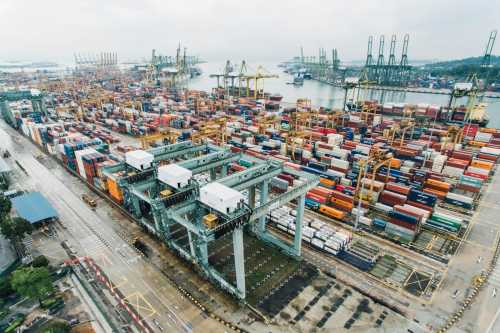
In April 1956, Malcom McLean loaded 58 aluminum containers onto the SS Ideal X, inaugurating the commercial shipping container era. That single innovation standardized the physical movement of goods, collapsing global freight costs and birthing the hyper-globalized supply chain. Seventy years later, the reverse is happening. Instead of physical standardization driving economic integration, regulatory, carbon, and monetary frameworks are standardizing fragmentation, imposing non-tariff barriers that are Balkanizing global commerce just as efficiently as the container once unified it.
The Fragmentation Catalyst
Across five concurrent wires this week—from the EU’s full activation of Carbon Border Adjustment Mechanism (CBAM) financial penalties to the Bank of Japan’s 50-basis-point rate hike, the launch of an Amazon-Maersk autonomous green shipping corridor, the formation of a $20B US-Mexico nearshoring trust, and the WTO’s adverse ruling on India’s electronics subsidies—a single structural reality has crystallized. The post-1990 consensus of frictionless, yield-chasing global trade has been formally replaced by a regime of priced externalities, sovereign industrial policy, and bifurcated capital markets.
Echoes of the Cobden-Chevalier Collapse
The most instructive historical parallel is not the oft-cited Smoot-Hawley Tariff Act, but the collapse of the Cobden-Chevalier free trade network in the late 19th century. When the multilateral free trade framework engineered by Britain began to fray in the 1870s, nations did not simply raise tariffs; they shifted to bilateral, protectionist blocs, leading to a 40% drop in global trade volumes over two decades. The lesson for today is that when the hegemonic enforcers of multilateral trade retreat from their role, the system does not just slow down—it actively fractures into competing, inefficient bilateral blocs. The WTO’s inability to enforce its ruling against India’s production-linked incentives is the modern equivalent of that retreat, signaling that multilateral arbitration is dead.
Margin Compression in the Mid-Cap Tier
Mainstream coverage of the EU’s CBAM activation focuses on the macroeconomic impact on Asian steel and aluminum exporters. The unseen implication is the severe margin compression facing Western mid-cap manufacturers who rely on these imported intermediates. According to the Peterson Institute for International Economics (PIIE) Q3 2026 trade monitor, non-tariff barriers now account for 68% of total trade friction costs, up from 42% in 2020. European mid-cap industrial firms, which lack the balance sheet to absorb a 15-20% input cost spike or the leverage to pass it fully onto end consumers, face an impending wave of insolvencies. The market is pricing this as a localized regulatory adjustment; it is, in fact, a structural repricing of European industrial viability.
The Green Premium as a Structural Moat
A compelling counter-argument, advanced by European industrial incumbents and ESG-focused capital allocators, posits that CBAM and similar carbon tariffs will ultimately strengthen, rather than weaken, domestic manufacturing. By internalizing the cost of carbon, the argument runs, Western firms are forced to modernize, while high-emitting foreign competitors are priced out of the market. In this view, the regulatory friction acts as a protective moat, allowing compliant, capital-intensive domestic producers to capture market share and achieve pricing power that was impossible under the race-to-the-bottom dynamics of the 2010s.
The Carry Trade Unwind and Emerging Market Contagion
The second unseen layer is the monetary shockwave originating from Tokyo. The Bank of Japan’s aggressive 50-basis-point hike has triggered a violent unwind of the yen carry trade, spiking global dollar-denominated borrowing costs. The transmission mechanism to the real economy is severe. Data from the Institute of International Finance (IIF) indicates that a 100-basis-point increase in dollar-denominated borrowing costs typically triggers a 14% default rate in emerging market corporate debt within 18 months. We are not just looking at currency volatility; we are looking at a systematic choking of capital access for emerging market corporates that relied on cheap yen liquidity to fund dollar-denominated expansion.
The Privatization of the Maritime Commons
The third unseen implication lies in the Amazon-Maersk autonomous green corridor. While framed as a sustainability initiative, this is fundamentally the privatization of maritime trade infrastructure. By bypassing traditional, unionized, and heavily regulated ports in favor of automated, proprietary terminals, these corporate entities are creating a two-tiered global shipping system. As former USTR Robert Lighthizer observed in a recent Foreign Affairs briefing, "We have moved from an era of comparative advantage to one of comparative security; the balance sheet must reflect geopolitical risk, not just labor arbitrage." The green corridor is the physical manifestation of this shift—a premium, insulated supply chain for mega-caps, leaving traditional merchants to navigate the congested, regulated, and increasingly expensive public maritime commons.
The Sovereign Right to Subsidize
Defenders of India’s PLI schemes, and similar industrial policies in the US and EU, argue that the WTO’s adverse ruling is an anachronistic infringement on sovereign economic development. They contend that in an era where the US has passed the CHIPS Act and the EU has deployed the Green Deal Industrial Plan, developing nations have an absolute right to utilize state capital to build domestic technological capacity. From this perspective, the WTO’s insistence on free-market orthodoxy is a tool used by late-industrializing nations to lock in the technological dominance of early industrializers, making the adverse ruling not a legal victory, but a geopolitical provocation.
The 90-Day Corporate Playbook
- For Mid-Cap Manufacturers: Immediately stress-test your bill of materials against a 20% increase in imported intermediate costs. Initiate dual-sourcing mandates for critical inputs, prioritizing nearshored suppliers within the USMCA or EU single market, even at a higher unit cost, to insulate against CBAM and non-tariff volatility.
- For Institutional Investors: Underweight emerging market corporate debt with high dollar-denominated exposure, specifically in sectors reliant on continuous capital expenditure. Overweight nearshoring enablers—specifically, Mexican industrial real estate investment trusts (REITs) and cross-border logistics providers backed by the new $20B nearshoring trust.
- For Mega-Cap Retailers: Evaluate the ROI of joining proprietary green corridors. If your freight volume justifies the capital expenditure, bypassing public ports will soon become a mandatory competitive advantage to guarantee delivery SLAs and hedge against public infrastructure strikes.
The Six-Month Horizon
By May 2027, the landscape will have fundamentally bifurcated. First, expect a visible spike in European mid-cap industrial insolvencies as the full financial weight of CBAM hits Q1 earnings, forcing a wave of M&A by larger, capitalized incumbents. Second, the yen carry trade unwind will force at least two major emerging market central banks to implement emergency capital controls to stem currency depreciation and corporate defaults. Third, the WTO will effectively enter a period of irrelevance as major economies formally ignore its rulings, accelerating the shift toward bilateral, security-aligned trade blocs. The era of the frictionless global market is over; the era of priced, fortified commerce has begun.
Related Articles

The Great Physicalization: Navigating the End of Financialized Corporate Strategy
Nov 22, 2026
The Supersonic Retrofit: Navigating the Convergence of Corporate Debt and Regulatory Friction
Nov 19, 2026
Comments (0)
No comments yet. Be the first to share your thoughts!
Want to join the discussion?
Please log in to post a comment.
Login NoworCreate an Account