
The Stagflationary Mirage: Tariff Front-Running, Central Bank Divergence, and the 2026 Growth Cap

Imagine a heavy freight train where the engine is burning fuel at maximum thermal capacity and the wheels are spinning violently against the rails, yet the actual forward momentum remains artificially capped by a mechanical governor. This is the precise mechanical reality of the global macroeconomic architecture in August 2026. The core event defining this cycle is the collision of superficially robust trade volumes with severe underlying demand destruction, as headline inflation cools marginally while central banks remain trapped in a divergent policy matrix. According to the Bureau of Labor Statistics, the annual inflation rate in the US slowed for a second consecutive month to 3.4% in July 2026, yet the IMF warns that global growth is projected to slow moderately to 3.0%, as the world economy navigates severe geopolitical disruptions [[3], [19]].
The Tariff Front-Running Illusion
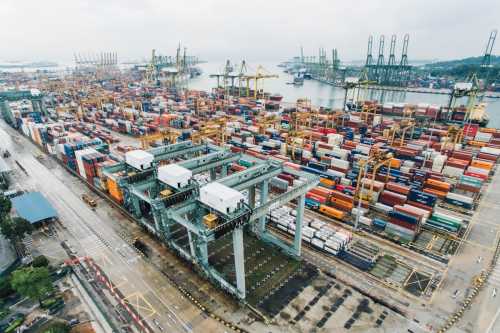
Mainstream financial desks are celebrating the latest data from the United Nations Conference on Trade and Development, which reveals that trade in goods grew 12.5% in the first half of 2026, reaching a staggering US$13.7 trillion [[31]]. The unseen implication that the consensus is entirely mispricing is that this volume surge is not a reflection of organic global demand expansion, but rather a massive, debt-fueled inventory front-running exercise. Multinational supply chain managers are aggressively pulling forward their Q3 and Q4 procurement schedules to bypass the implementation of a new 15% tariff regime targeting critical industrial components. This artificial acceleration masks a severe underlying contraction in actual end-consumer demand, creating a dangerous inventory overhang that will violently hit corporate balance sheets once the tariff deadlines pass. The market is treating this nominal trade expansion as a sign of resilient global consumption, ignoring the fact that it is entirely subsidized by corporate working capital depletion.
Counter-Narrative: The Supply Chain Hardening Premium
Conversely, industrial strategists and reshoring advocates argue that this trade volume spike represents a permanent structural hardening of global supply chains, rather than a transient panic response. The counter-argument posits that the 12.5% growth in physical goods is driven by the massive capital expenditure required to build redundant, localized manufacturing nodes in North America and Southeast Asia. From this perspective, the upfront cost of importing heavy machinery and raw materials to construct these new facilities is a necessary, one-time inflationary impulse that will ultimately yield a deflationary, highly resilient domestic production base by 2028. Proponents assert that judging this trade surge by traditional cyclical demand metrics is a category error; it is actually a sovereign capital investment in industrial security that will insulate Western economies from future commodity shocks.
Echoes of the 1979 Stop-Go Monetary Trap
To contextualize the current paralysis in global monetary policy, one must examine the stop-go interest rate cycles of the late 1970s, specifically the period immediately preceding Paul Volcker’s appointment to the Federal Reserve. During that era, central banks would prematurely cut rates at the first sign of economic slowing, only to be forced into aggressive, destabilizing hikes when inflation expectations re-anchored higher. Today, the analog is the European Central Bank's paradoxical posture; having paused its tightening cycle in July, few economists believe it is done raising interest rates, with threats of further hikes looming over the 2026 horizon before any cuts materialize in 2027 [[16]]. The historical lesson from 1979 is that when central banks lack the conviction to maintain a permanently restrictive stance, they inadvertently validate inflation expectations, forcing the corporate sector to build permanent cost-of-living adjustments into long-term wage contracts. The current policy hesitation is not a sign of macroeconomic mastery, but a structural failure that guarantees a higher terminal floor for global borrowing costs.
The Divergence Trap and Emerging Market Liquidity
Beneath the surface of the G7 economies, a severe policy divergence is actively draining liquidity from the developing world. With year-end interest rate expectations for the US Federal Reserve hovering around 3.89%, while the ECB and Bank of England maintain higher restrictive postures, a massive foreign exchange vortex is forming [[13]]. The unseen implication for the global economy is the forced liquidation of Emerging Market (EM) sovereign debt. As European capital seeks the relative yield safety of UK and Eurozone instruments, and US capital remains trapped domestically by onshoring mandates, EM nations are being starved of the dollar-denominated refinancing required to roll over their pandemic-era liabilities. This divergence is not merely a currency fluctuation; it is a structural reallocation of global capital that will force developing nations to slash domestic infrastructure spending and impose severe capital controls to prevent total currency collapse.
Counter-Narrative: The Intangible Economy Buffer
Optimistic growth theorists counter the stagflation thesis by pointing to the rapid expansion of the intangible economy, which remains entirely decoupled from physical supply chain bottlenecks and commodity shocks. The counter-argument highlights that alongside the surge in physical goods, services trade grew by 10.5%, adding roughly US$2 trillion to global trade volumes [[6]]. Proponents argue that the digitalization of global commerce—spanning cross-border software licensing, AI-driven intellectual property transfers, and remote engineering services—provides a massive, deflationary buffer that offsets the inflationary friction of physical tariffs and energy shocks. From this vantage point, the fixation on physical goods trade is an archaic metric; the true engine of global wealth creation has migrated to the services sector, which scales infinitely without requiring the physical shipping containers that are currently bottlenecked by geopolitical friction.
Official UNCTAD Global Trade Update (H1 2026)
"Trade in goods grew 12.5% in the first half of 2026, reaching US$13.7 trillion. Our Global Trade Update tracks where trade is heading, every quarter." Read the Official UNCTAD Facebook Release
Defensive Architecture for the Mid-Market Enterprise
For local businesses, mid-market manufacturers, and retail citizens, navigating this regime requires an immediate pivot from growth-optimization to aggressive working capital preservation. Corporate treasurers must ruthlessly audit their inventory levels, recognizing that the current 12.5% trade surge is a leading indicator of a Q4 inventory glut that will force severe margin compression and localized discounting. Enterprises must utilize forward currency contracts to lock in exchange rates against the Euro and Pound, as the central bank divergence will trigger violent, unpredictable FX swings that can obliterate the operating margins of import-heavy businesses. Furthermore, citizens should view the marginal cooling of US inflation to 3.4% not as a signal to increase leverage, but as a temporary plateau before the secondary inflationary effects of the new 15% tariff regime fully permeate the consumer price index in late 2026.
The Q1 2027 Reckoning: Inventory Glut and Yield Spikes
Looking six months ahead to the first quarter of 2027, the macroeconomic landscape will be defined by the violent unwinding of the tariff front-running illusion and a severe repricing of sovereign risk. As the physical inventory glut hits distribution centers in January, the apparent strength in global trade volumes will collapse, exposing the underlying demand destruction that the IMF’s 3.0% growth cap has been warning about. Simultaneously, the ECB’s anticipated rate hikes will trigger a liquidity crisis in the European periphery, forcing the European Central Bank to abandon its tightening rhetoric and engineer an emergency liquidity facility to prevent a sovereign debt spiral. The landscape will transition from a period of artificial, debt-fueled trade expansion to one of brutal inventory liquidation and forced monetary capitulation, separating the highly leveraged enterprises from those that maintained fortress balance sheets during the stagflationary mirage of 2026.
Related Articles

The Macroeconomic Inflection Point: Navigating Sovereign Debt, Labor Recalibration, and Trade Fragmentation
Aug 22, 2026
The Macroeconomic Reckoning: Navigating the Convergence of Debt, Trade, and Technological Shifts
Aug 22, 2026
Comments (0)
No comments yet. Be the first to share your thoughts!
Want to join the discussion?
Please log in to post a comment.
Login NoworCreate an Account