
The Foundation of Sand: Navigating the Structural Fault Lines of the 2026 Global Order


The Foundation of Sand: Anatomy of the 2026 Global Repricing
Treating the current global economic order like a heavily leveraged real estate portfolio requires ignoring the shifting tectonic plates beneath the foundation while fixating solely on the cosmetic renovations of headline GDP growth. This structural dissonance defines the present geopolitical landscape. The core event anchoring this analysis is the simultaneous consolidation of the BRICS bloc, which now commands 20% of global imports, colliding with the United Nations General Assembly’s landmark 2026 resolution endorsing state obligations on climate change, all set against a backdrop of escalating sovereign default risks in emerging markets cgljresourcehub.law.northeastern.edu , www.hinrichfoundation.com .
The Margin Mirage: Supply Chain Bifurcation and the Nearshoring Premium
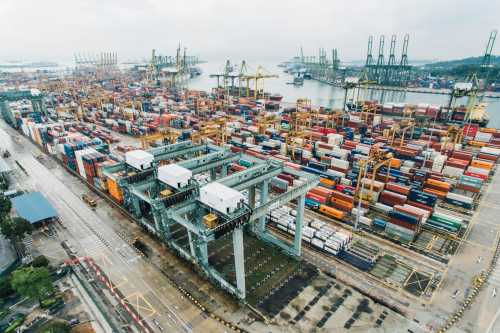
Mainstream financial commentary frequently isolates supply chain nearshoring as a seamless operational upgrade, ignoring the far more consequential tremors in global trade geometries. The unseen implication for international commerce is a severe compression of viability for mid-tier emerging economies. Industry analysis confirms that while "companies that get nearshoring right can increase gross margins by up to 30%," the execution is exceptionally difficult, with "only 2% of respondents" reporting successful implementation www.bain.com . This dynamic forces a radical repricing of global logistics. Multinational conglomerates are no longer viewing diversified, cost-optimized supply chains as stable growth vectors, but as fragile liabilities. The capital expenditure required to build redundant, localized manufacturing nodes is quietly cannibalizing research and development budgets, a reality entirely absent from consensus corporate earnings estimates. Consequently, we are witnessing a flight to quality that leaves developing nations, previously reliant on export-led growth, starved of foreign direct investment.
The Sovereign Debt Trap: Fiscal Paralysis in the Global South
Beyond trade logistics, the operational architecture of emerging market stability is undergoing a silent, asymmetric shift. The prevailing narrative of post-pandemic economic recovery obscures a more brutal reality of logistical fragmentation and resource scarcity. Primary research indicates that "political constraints, characterized by the degree of flexibility to choose fiscal policies, affect the probability of sovereign default," trapping nations in a cycle of debt servicing rather than productive investment www.sciencedirect.com . This dynamic creates a bifurcated financial landscape: well-resourced economies can absorb the shock of elevated global interest rates, while frontier markets face compounding margin compression as they attempt to manage both ecological degradation and civil unrest without the requisite fiscal depth. This triggers a feedback loop of capital flight, currency devaluation, and institutional decay that traditional multilateral aid is entirely unequipped to resolve.
The Securitization of Displacement: Climate Migration as a Fiscal Drain
A third ignored implication is the latent vulnerability within the international regulatory framework regarding human mobility. While macroeconomic debates dominate national airwaves, the operational reality is that climate-induced migration is being systematically weaponized as a border security expense. Academic reviews of the climate-migration-conflict nexus note that "securitising climate migration diverts attention from adaptation and justice-based responses, leading to reactive border policies rather than proactive resilience" www.elgaronline.com . This dynamic traps mid-tier diplomatic initiatives in a cycle of rhetorical stagnation, where genuine developmental partnerships are secondary to satisfying stringent domestic political constituencies. Consequently, the global supply chain for humanitarian and adaptive capital remains dangerously concentrated, ensuring that the next climate shock will trigger immediate, catastrophic resource hoarding by developed nations, replicating the worst failures of recent global crises.
Counter-Argument: The Efficacy of Strategic Nearshoring
Conversely, it is analytically necessary to acknowledge that the bearish interpretation of supply chain fragmentation overlooks the foundational logic of operational de-risking. Proponents of aggressive nearshoring argue that while initially costly, this transition permanently insulates corporate revenue streams against future geopolitical shocks and logistical bottlenecks. By internalizing production closer to end markets, firms eliminate the hidden costs of transoceanic freight volatility and intellectual property leakage. From this perspective, the current friction is not a systemic failure, but a necessary, temporary calibration period that ultimately yields a more robust, geographically diversified corporate ecosystem resistant to external disruptions.
Echoes of the 1970s: The New Non-Aligned Resource Nationalism
To understand the current trajectory of global realignment, one must examine the geopolitical shock of the 1970s Non-Aligned Movement coupled with the oil embargoes. During that era, massive capital deployment and resource nationalism were weaponized by a coalition of developing nations to extract concessions from industrialized powers, fundamentally rewiring global trade routes and monetary systems. The lesson from that historical precedent is that resource leverage consistently outpaces the diplomatic readiness of established hegemonies. Just as the 1970s energy crisis culminated in the creation of new financial recycling mechanisms and a permanent shift toward strategic commodity reserves, the current BRICS-led realignment will inevitably force a shakeout of outdated diplomatic frameworks, leaving only those institutions capable of offering tangible, non-conditional economic partnerships.
Counter-Argument: The Resilience of Alternative Financial Architectures
However, arguing that emerging markets are on the precipice of a systemic debt crisis ignores the substantial institutional buffers they have recently deployed. Institutional economists counter that unlike previous decades, today’s Global South is actively constructing parallel financial architectures, including local currency settlement mechanisms and expanded multilateral development banks, which de-risk them from Western monetary policy tightening. This institutional maturity provides a critical shock absorber, suggesting that the current friction is not a collapse of the developing world, but a strategic decoupling that will ultimately foster long-term, sustainable economic sovereignty independent of the US dollar's fluctuations.
Strategic Hedging: Imperatives for the Mid-Market Enterprise
For multinational corporations, institutional investors, and citizens, navigating this bifurcated environment demands immediate, defensive recalibration of geopolitical risk strategies. First, corporate supply chain managers must aggressively audit their vendor networks, transitioning from single-source, cost-optimized procurement to diversified, regionally compliant models to avoid sudden regulatory or logistical freezes. Second, agribusinesses and resource-intensive industries should abandon fragile extraction models in climate-vulnerable regions, pivoting instead toward localized, resilient supply networks. While this incurs higher initial carrying expenses, it insulates the firm from ecological shocks and civil unrest. Finally, citizens and local businesses must proactively engage with municipal resilience planning, ensuring that critical infrastructure investments prioritize water security and decentralized energy grids over speculative, centralized projects that are vulnerable to macroeconomic volatility.
The 180-Day Horizon: Entrenched Fragmentation and Distressed Assets
Projecting six months into the future, the geopolitical landscape will harden into a state of entrenched multipolar fragmentation. We will likely witness the onset of a "liquidity credit crunch" in frontier markets, a phenomenon where mid-tier nations, unable to secure affordable financing from traditional Western institutions or navigate complex supply chain transitions, are forced into asymmetric, resource-backed bilateral agreements with BRICS entities. Conversely, well-capitalized G7 nations and mega-cap conglomerates will solidify their technological and logistical moats, leveraging massive institutional subsidies to dictate market terms and acquire distressed assets at a discount. The next six months will not necessarily yield a catastrophic, systemic global conflict, but rather a prolonged, grinding erosion of diplomatic trust and mid-market viability. The entities that survive and thrive will be those that have decisively decoupled from the illusion of a unipolar world, adapting instead to a reality where strategic autonomy and resource fortitude are the only permanent currencies.


Comments (0)
No comments yet. Be the first to share your thoughts!
Want to join the discussion?
Please log in to post a comment.
Login NoworCreate an Account