
The Oven-Door Economy: The Fed Tightens While Washington Keeps Heating Prices

MACRO & MONETARY POLICY — IMPACT ANALYSIS | Week of Aug. 17, 2026
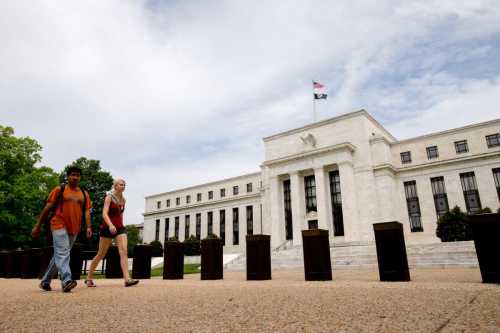
Any homeowner who has tried to cool a kitchen in August knows the physics: the air conditioner wins only if the oven stays shut. Prop the oven door open and the compressor runs hot, the meter spins, and the room never cools. Washington is now running that experiment on the U.S. economy — one hand of the state paying to cool demand while the other props the door open with fresh import duties. In a single week, the Kevin Warsh-led Federal Reserve left a rate hike on the table as early as September, with futures markets assigning roughly a 55% probability to a quarter-point move, while the White House stacked a new Section 232 duty of up to 100% on imported drones atop a tariff regime the Tax Foundation calculates costs the average household $900 a year. That is the policy contradiction of 2026: a central bank tightening into supply-side inflation that the government itself administers.
What the Headline Tape Misses
Start with the quiet tightening already embedded at the long end of the curve. With the policy rate pinned since Warsh succeeded Jerome Powell as chair in May, mortgage and corporate yields have nonetheless climbed, because the market no longer trusts the reaction function. "Higher long-maturity bond yields reflect investor concerns that inflation remains stubbornly above the Fed's target," Columbia Business School economist Brett House noted this month, calling Fed communication "both muddled and absent." For the mid-market operator, the effective cost of capital is therefore rising without a single FOMC vote: revolvers price off prime, and a December hike to 3.75%–4.0% pushes prime toward 7%. Layer on the working-capital drag of front-loading inventory to beat the Sept. 3 drone duty and the Feb. 9, 2027 component duty — inventory now financed at those higher rates — and you have a squeeze that never appears in the policy statement.
Then there is the divergence between the tape and the till. The S&P 500 and the Russell 2000 both printed records last week, yet Commerce reported consumer spending fell unexpectedly in July, payrolls posted a shocking loss, and gasoline topped $4 a gallon — a level GasBuddy's Patrick De Haan says has never been recorded at this point of the year. That is a K-shaped economy in its pure form, and the risk concentrates in import-dependent, low-margin retail that cannot pass through a $900-per-household tariff tax. "You are seeing pockets of weakness or some cracks out there," RBC Capital Markets' Steve Shemesh observed ahead of this week's Walmart, Target and Home Depot reports. When the index sits at a record while the marginal consumer eats into savings, earnings risk is not symmetric: it resides on the downside of any name whose customer is the bottom two income quintiles.
The deepest implication is regime uncertainty. Warsh has curtailed forward guidance, tasked five working groups with reviewing the dot plot, the balance sheet and the inflation framework, and left open whether PCE remains the target. J.P. Morgan chief U.S. economist Michael Feroli was blunt: the vagueness "raises questions about the new chair's credibility in delivering lower inflation, and we believe this will add some urgency for the rest of the committee to act on its mandate." A central bank without a readable reaction function forces markets to price the worst-case path — which is why FedWatch now leans toward an October move and "higher for longer" has become self-executing tightening. Credibility, once spent, is the most expensive asset on any central bank's balance sheet. This one is being amortized in real time.
The Bull Case Deserves a Hearing
To be fair, the counter-reading carries weight. Announced job cuts ran 41% below last year's pace through the first seven months of 2026, Deloitte's global outlook tracks, and CFRA's Sam Stovall argues that record prints across his coverage "tends to imply favorable price performances for the next several months." If Warsh's thesis — that AI delivers a disinflationary productivity shock — lands, the Fed can hike pre-emptively and stand down without a recession. Peter Graf, CIO at Amova Asset Management Americas, framed the July hold charitably: with the labor market softening, "it may be more important for central bankers to be lucky than good." The bears may be overpricing the cracks, and the tariff burden may prove absorbable against still-solid aggregate balance sheets. The honest read is a bimodal distribution of outcomes in which markets are pricing chiefly the benign tail.
Volcker's Ghost and the Lesson of 1981
The nearest analog is 1980–82. Paul Volcker tightened into a second oil shock while Washington layered protectionism on top — the 1981 voluntary export restraints on Japanese autos and emergent steel quotas raised goods prices even as monetary policy crushed demand. The lesson is not that tightening failed; it is that credibility sets the sacrifice ratio. Volcker's ruthless consistency anchored expectations and broke inflation, but the bill arrived as the 1981–82 recession and a manufacturing sector squeezed between dear credit and administered trade costs. Warsh's Fed now faces the same pincer — restrictive policy plus tariff-led goods inflation — without yet possessing Volcker's communicated resolve. The precedent says inflation can be beaten under that mix, but only by paying, up front, in credibility.
When a Duty Is a Shield, Not a Tax
Nor is the tariff side as one-dimensional as the free-trade catechism insists. The Aug. 13 drone proclamation is structured as industrial-security policy: 100% duties on heavier, thermal-imaging-capable systems, 25% on smaller platforms, reduced rates for compliant suppliers, and a runway until February 2027 for components precisely so domestic capacity can come up the curve. U.S. dependence on Chinese unmanned systems is a documented supply-chain vulnerability, and the CHIPS precedent shows administered protection, paired with incentives, can re-shore strategic output. The $900 household figure is an average that blends strategic categories with consumer goods; treating every duty line as pure tax ignores the option value of resilience. The defensible critique is not that the drone tariffs exist, but that they land while the Fed fights inflation — the shield and the oven door, again.
Positioning Before the Pincer Tightens
For operators and households, the playbook is defensive but active:
- Term out floating exposure. Prime sits near 6.75%; a December hike pushes it toward 7%. Every revolver left floating is a quiet distribution of equity.
- Map HTS exposure to the Sept. 3 and Feb. 9, 2027 effective dates and claim compliant-supplier reduced rates where available. Front-loading financed at 7% prime is a margin trap — model the carry before the duty saving.
- Run a two-tier price architecture: defend entry-price-point SKUs for the squeezed consumer; take margin where the affluent cohort still spends.
- Households: retire prime-linked variable debt — cards, HELOCs — first, and let T-bills north of 3.5% pay you to wait.
- Investors: treat index records as a composition effect, not a health certificate.
February 2027, Sketched in Pencil
Six months out, the base case is one delivered 25-basis-point hike — December, in J.P. Morgan's pulled-forward forecast — leaving the funds rate at 3.75%–4.0% and a divided committee arguing in public. A fourth-quarter import front-load ahead of the component duty will flatter the trade deficit; tariff pass-through will hold core goods inflation above target even as the labor market softens, flipping the debate from "hike or hold" to "hold or cut" by early 2027. The dollar and the term premium stay elevated, low-income credit stress surfaces in charge-offs, and the drone supply chain re-contracts around compliant suppliers. The scarce asset in that world is not liquidity; it is a readable, credible policy rule. Until Washington closes the oven door, the compressor keeps running.


Comments (0)
No comments yet. Be the first to share your thoughts!
Want to join the discussion?
Please log in to post a comment.
Login NoworCreate an Account